How much does fine-tuning Prithvi improve burned-area mapping?
A geographic holdout experiment comparing U-Net, frozen Prithvi features and partial fine-tuning on HLS imagery.
1. Research question
When adapting a pretrained Earth observation foundation model such as Prithvi for wildfire burn-scar segmentation, how much performance is gained by partially fine-tuning the backbone (~51M trainable parameters) compared with training a lightweight decoder on frozen Prithvi features (<1M trainable parameters) or training a U-Net baseline from scratch?
2. Study area and datasets
The experiment uses a geographically partitioned Harmonized Landsat Sentinel-2 (HLS) burn-scar segmentation dataset comprising 485 training chips, 118 validation chips, and 163 test chips, with 38 buffer chips excluded to maintain spatial separation under a 100 km block split.
3. Methodology
Three segmentation configurations were trained and compared under identical data splits: a standard U-Net baseline, a decoder attached to frozen Prithvi backbone features (<1M trainable parameters), and a partially fine-tuned Prithvi encoder-decoder (~51M trainable parameters). Model checkpoints were selected using validation performance. Uncertainty in the IoU gain between partial fine-tuning and frozen features was quantified via paired spatial-block bootstrapping.
4. Scientific figures and maps
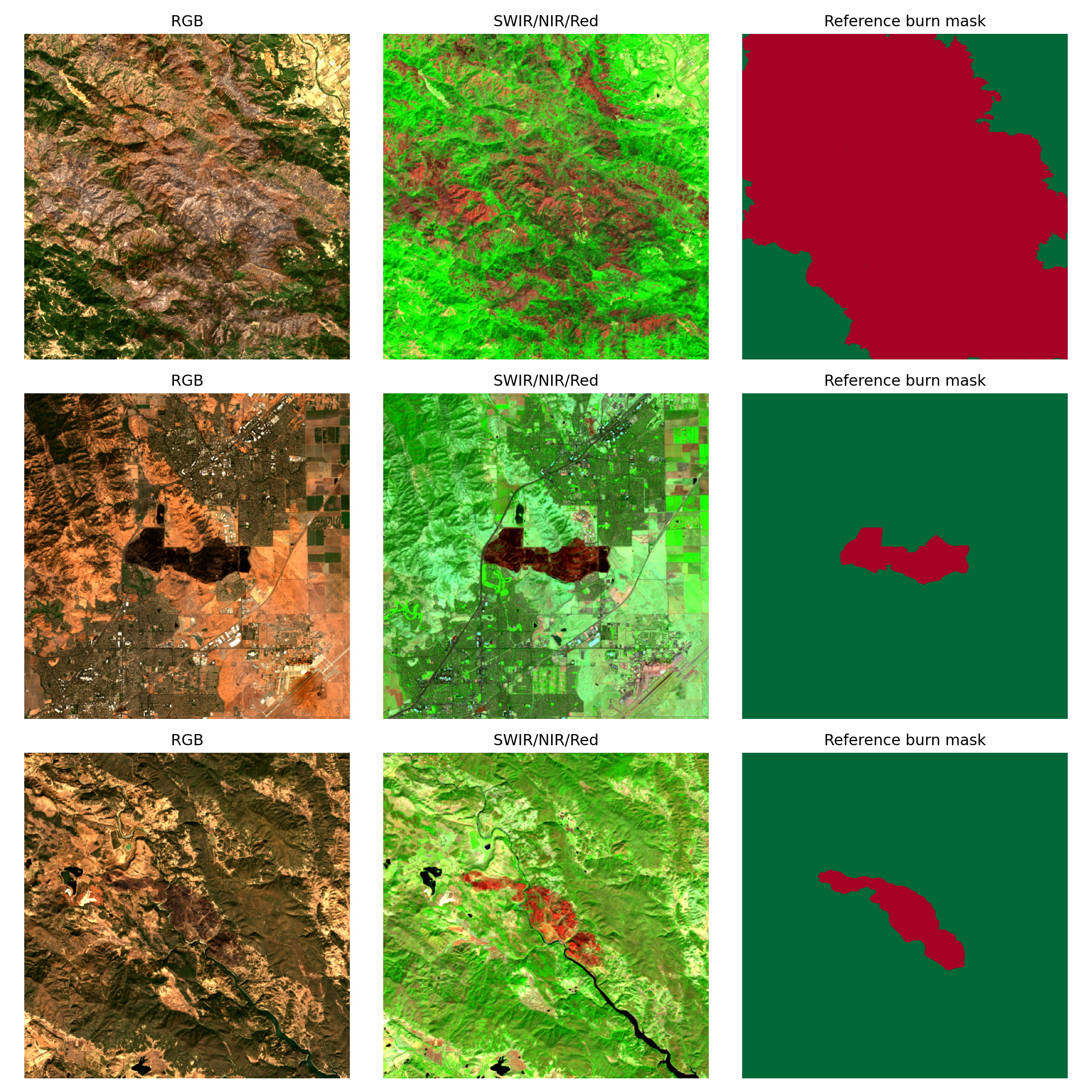
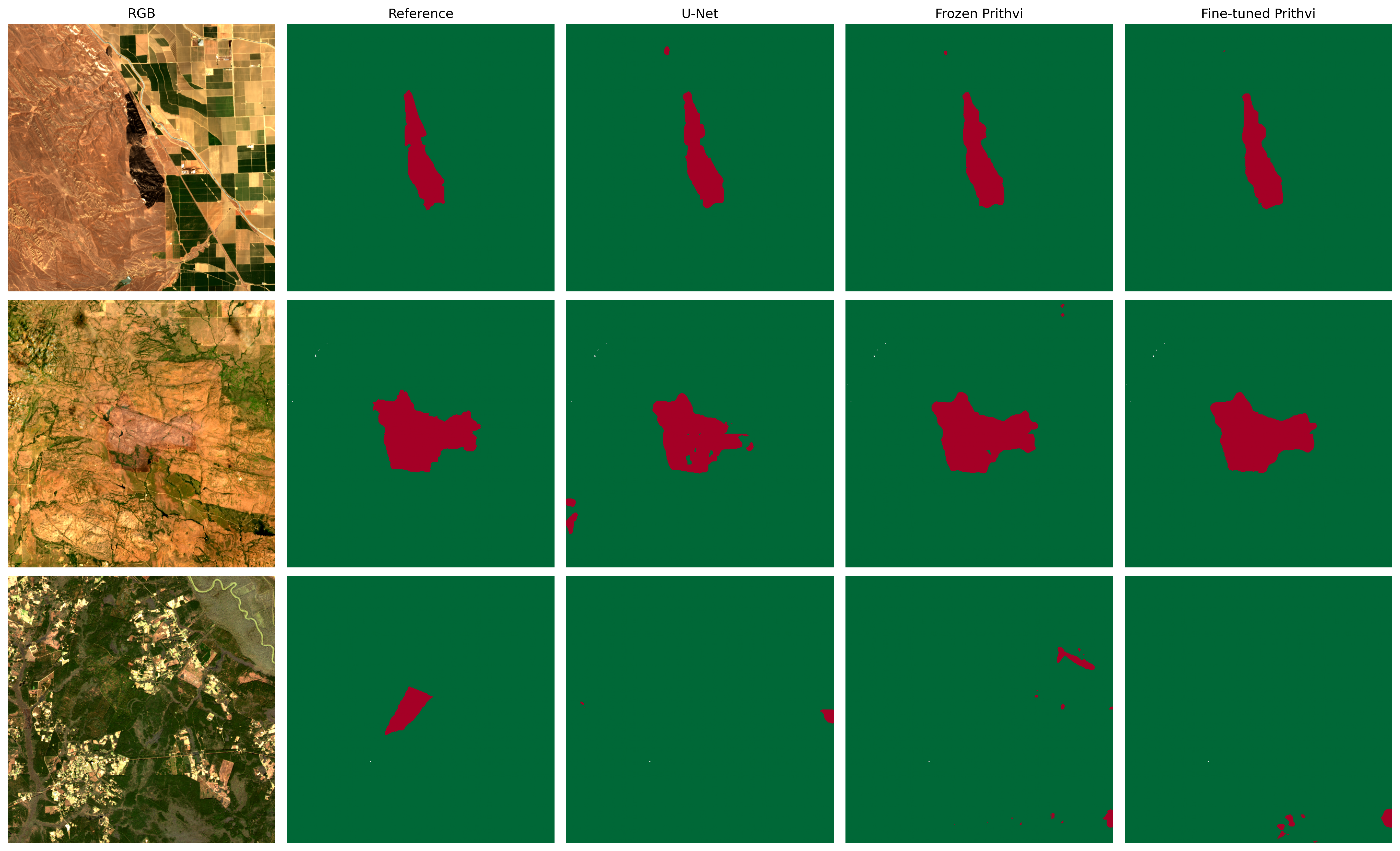
5. Results
| Model | Burn IoU | F1 |
|---|---|---|
| U-Net | 0.7550 | 0.8604 |
| Frozen Prithvi | 0.8144 | 0.8977 |
| Partially fine-tuned Prithvi | 0.8221 | 0.9024 |
Frozen Prithvi features substantially outperformed the U-Net baseline (+5.94 percentage points IoU). Partially fine-tuning ~51M parameters added a further 0.77 percentage points in burn IoU over frozen features, with a paired block-bootstrap interval of 0.24 to 1.44 percentage points.
6. Limitations
Qualitative inspection reveals failure cases (such as the third held-out example) where all three models miss a reference burn scar despite high aggregate IoU. Furthermore, these results reflect performance on a curated 100 km geographic holdout and do not establish generalization across unseen continents or independent fire seasons.
7. Reproducible code and references
- Study artifacts: Training examples, spatial split diagnostics, and held-out prediction figures are archived in this site’s figure directory; standalone training scripts are not yet linked publicly.