Predicting soil organic carbon from satellite embeddings
What a spatially buffered Spanish LUCAS pilot reveals about model performance and uncertainty.
1. Research question
Can learned satellite embeddings outperform conventional bare-soil optical and environmental predictors when predicting topsoil organic carbon (SOC) concentration in g/kg under strict spatial buffering, and how well calibrated are predictive uncertainty intervals across concentration ranges?
2. Study area and datasets
The pilot evaluates topsoil organic carbon concentration (g/kg, rather than carbon stocks) across Spanish cropland observations from the LUCAS topsoil survey. Out of 601 eligible cropland records, 533 samples had complete common predictor coverage across optical, environmental, and satellite-embedding features.
3. Methodology
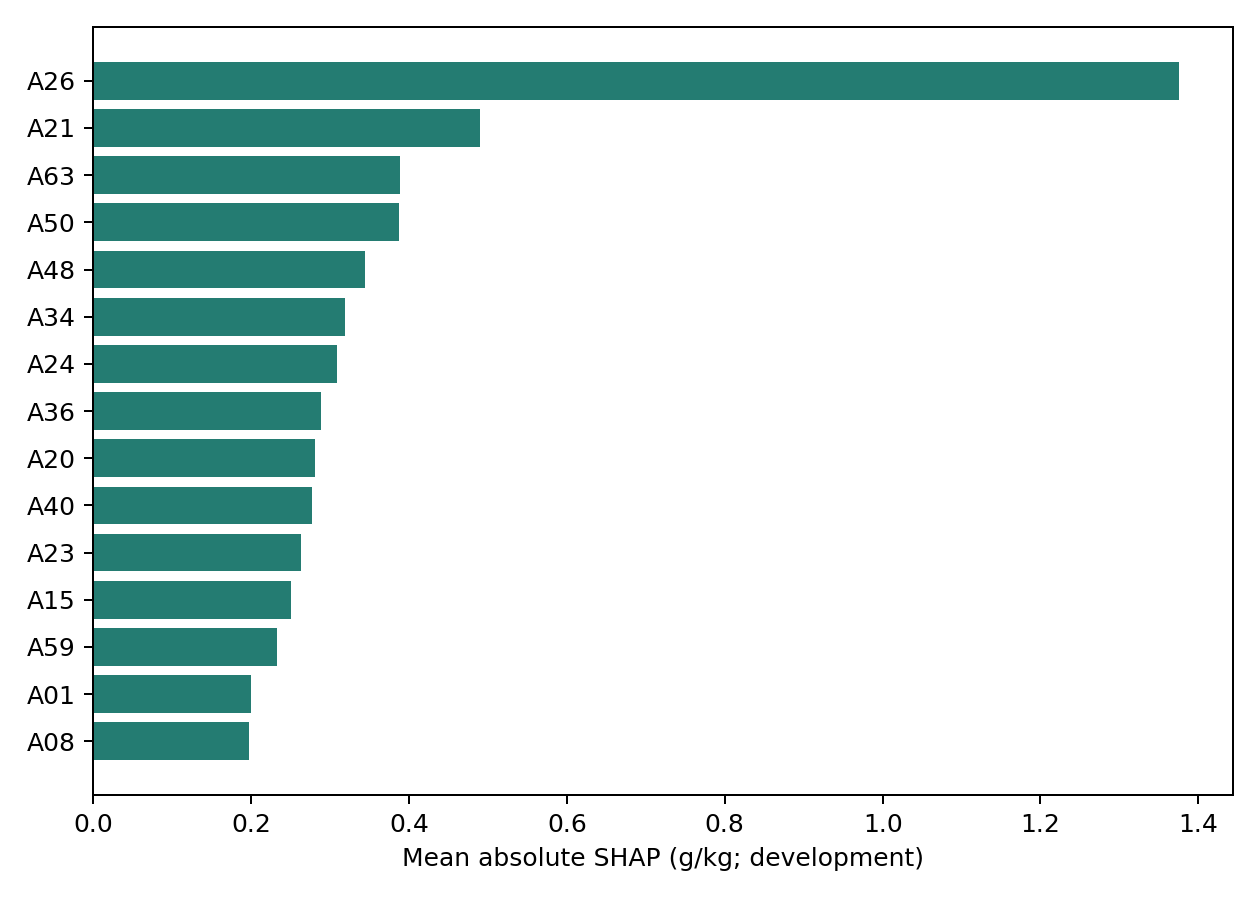
A frozen spatial split retained 402 development samples and 115 held-out test samples, excluding 16 observations falling inside the spatial buffer zone. CatBoost regression models were trained using spatial cross-validation on development data to compare optical, environmental, bare-soil, and satellite-embedding predictor sets. Residual-quantile intervals (nominal 90%) and development-set SHAP feature importances were evaluated on the spatial holdout.
4. Scientific figures and maps
5. Results
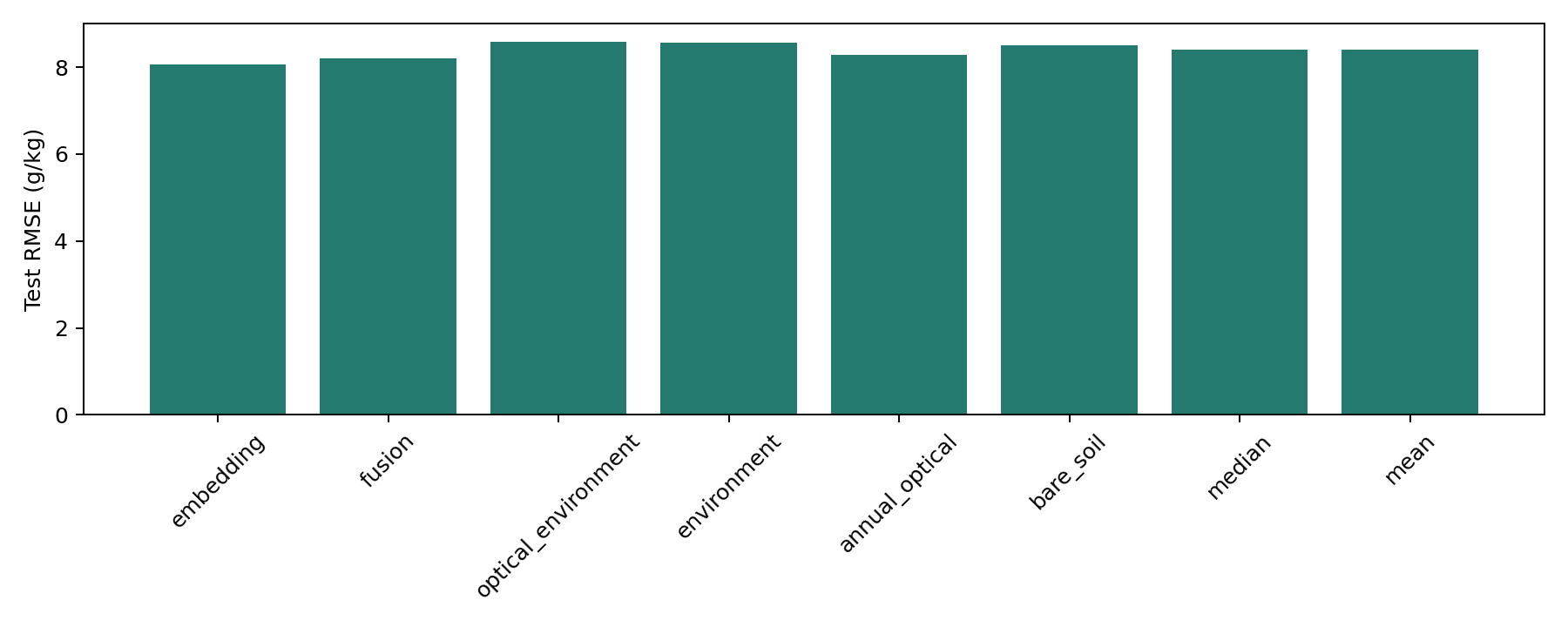
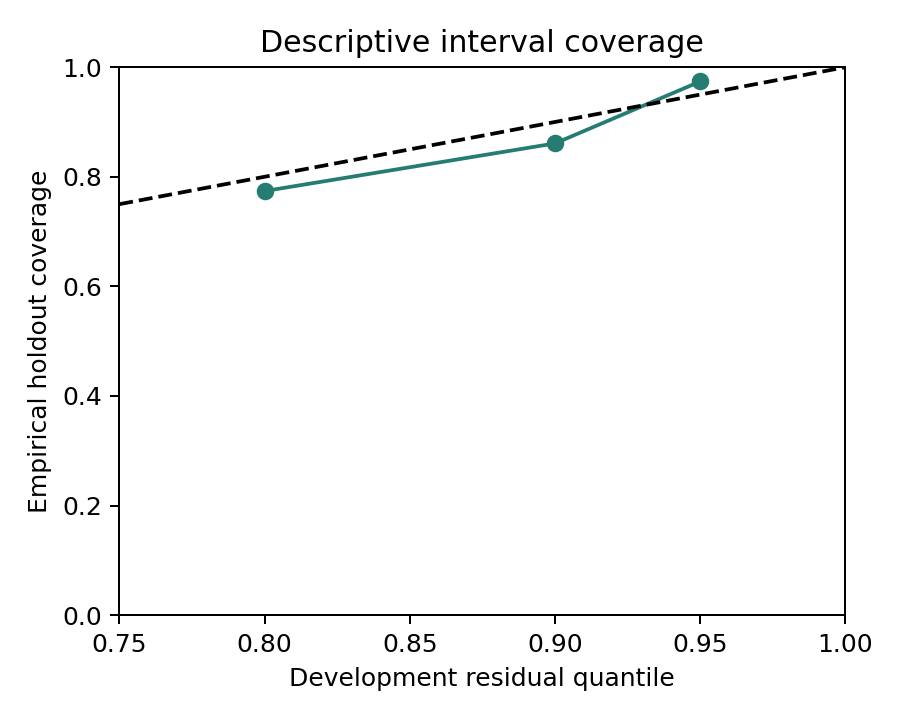
The development-selected embedding CatBoost model achieved a held-out RMSE of 8.07 g/kg and R² of 0.071. Its RMSE advantage over the bare-soil comparator was 0.423 g/kg, with a paired spatial-block bootstrap interval spanning zero. Across the full holdout, a nominal 90% residual interval achieved 86.1% empirical coverage, but coverage dropped to 47.1% for test observations above the development upper quartile.
6. Limitations
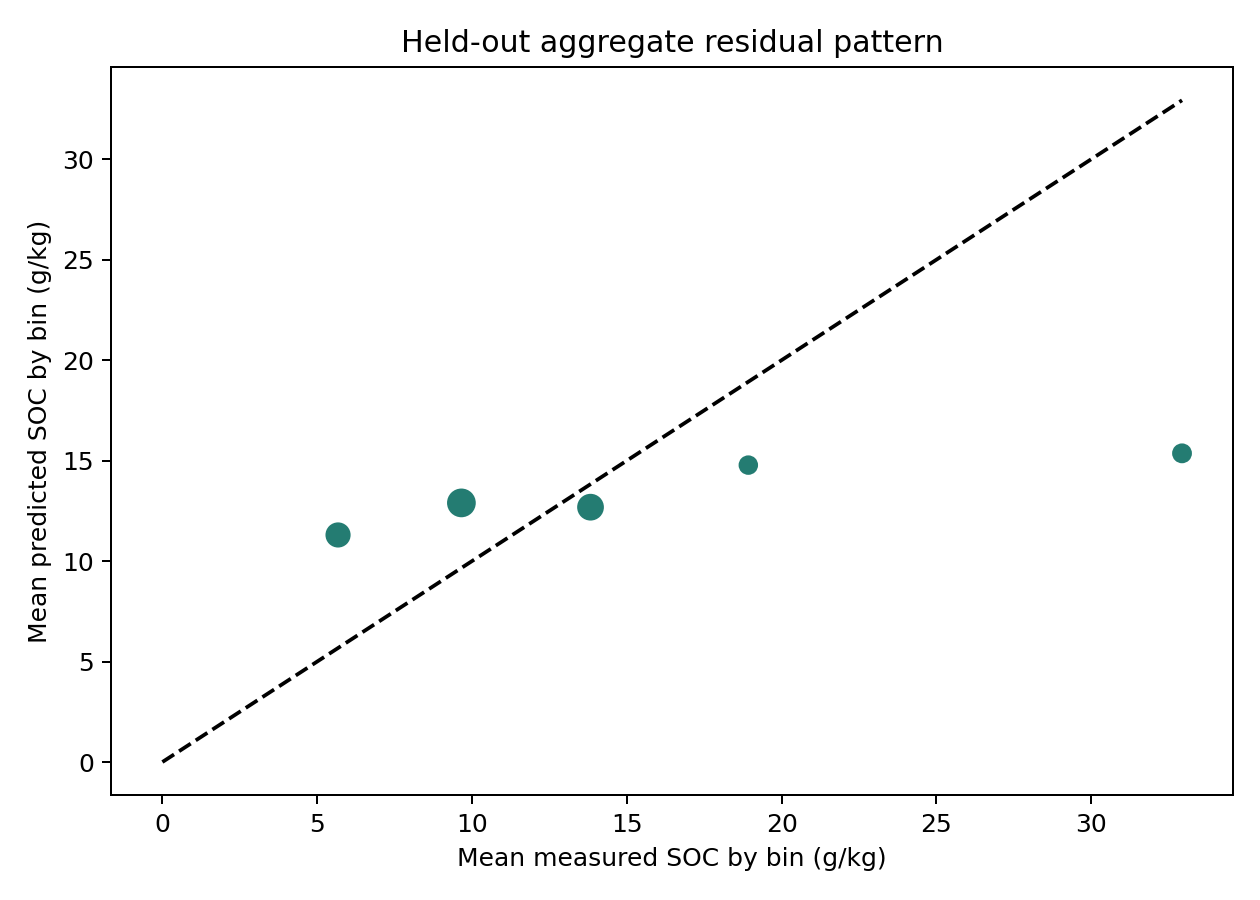
Predictions regressed strongly toward the mean of the target distribution, severely underestimating high-SOC cropland soils and losing interval calibration in the upper tail. Because embedding improvements over bare-soil predictors spanned zero under spatial-block resampling and SHAP dimensions lack direct physical interpretability, reporting failure regimes and interval miscalibration alongside RMSE is essential. No restricted reference records are reproduced here.
7. Reproducible code and references
- Study artifacts: Diagnostic RMSE, residual bias, coverage, and SHAP figures are included above; standalone notebooks are not yet published in a separate repository.